The city that belonged to the world
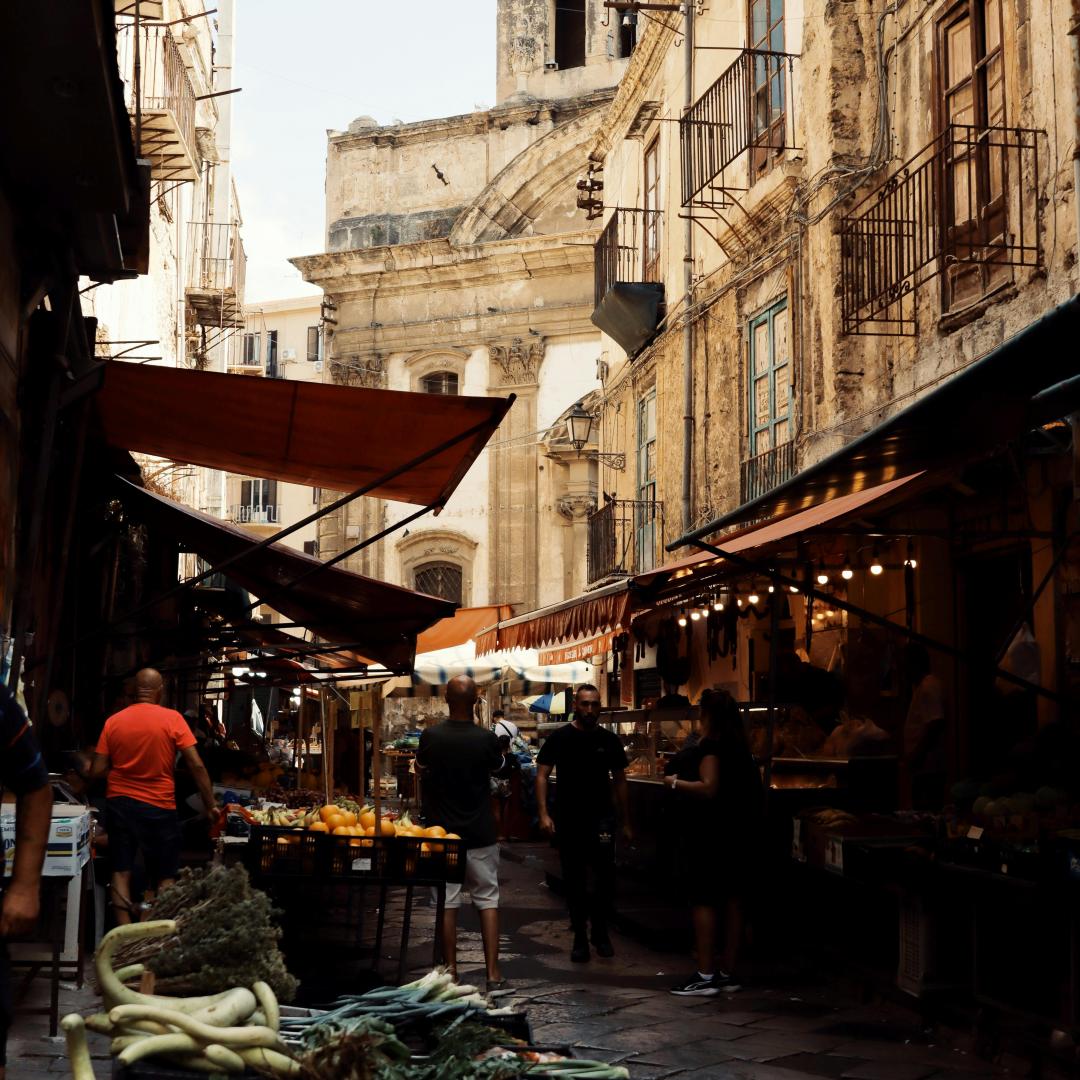
Follow a narrow street and one century becomes another. Golden mosaics give way to lively markets, noble façades to everyday rituals. In Palermo, beauty rarely belongs to a single time or culture. It emerges from the extraordinary conversation between them.
There are cities that seem to belong to a single time, a single culture, a single way of life.
Some cities are shaped by their history. Others are shaped by the many worlds that have passed through them.
For centuries, this Mediterranean city has existed at the meeting point of different civilisations, each leaving behind something of its language, its imagination and its understanding of beauty. The result is not a city of separate histories, but one in which they continue to speak to one another. A golden mosaic catches the afternoon light. An ancient street opens onto a Baroque façade. Beyond a monumental doorway, the sounds of everyday life reveal another side of the city. Nothing seems to belong entirely to one world. And perhaps that is what has always made Palermo so fascinating to travellers.
During the eighteenth and nineteenth centuries, when the Grand Tour became an essential journey of cultural discovery for Europe's young aristocrats and intellectuals, Sicily offered something that could not easily be found elsewhere. Here, history was not confined to museums or ancient ruins. It was alive in the streets, in the architecture, in the rituals of daily life and in the extraordinary coexistence of influences that had shaped the island. Writers, artists and curious minds arrived seeking knowledge and inspiration.
Among them was Guy de Maupassant, whose travels through Sicily would later find expression in La Vie Errante, published in 1890. But Palermo offered something beyond the monuments that filled travellers' notebooks. It challenged the idea that a place could be understood through a single perspective. Every neighbourhood revealed another layer. Every encounter suggested another story. Every architectural detail seemed to belong to a conversation that had begun centuries earlier and was still unfolding. To wander through Palermo is to experience this continuous dialogue between past and present.
It is to discover that a city's identity is not necessarily defined by what remains unchanged, but by its extraordinary capacity to absorb, transform and reinvent. And perhaps this is the true wonder of places where cultures meet. They remind us that beauty rarely belongs to one tradition alone.
Sometimes, the soul of a city is made of all the worlds it has welcomed.
Close